Golf Club Loft, Lie, and Shaft Flex Explained
Learn what loft, lie, and shaft flex mean, why they matter for beginners, and how to choose the right specs without overcomplicating it.

If you've ever stood in a golf shop and heard someone mention "standard lie angle" or "regular flex," and nodded along while having no idea what they meant, this guide is for you. Loft, lie, and shaft flex are three numbers that show up on almost every club spec sheet. Once you understand what they control, buying clubs and reading reviews becomes a lot less confusing.
At a Glance
- Loft is the clubface angle. Higher loft (a wedge) launches the ball higher and shorter; lower loft (a driver) launches it lower and longer.
- Lie angle is the shaft-to-ground angle at address. Standard lie fits most beginners; only chase a custom fitting once your misses are consistent in one direction.
- Shaft flex should match your swing speed, not your ego. Most recreational golfers belong in regular (R) flex, not stiff.
- Driver loft in the 10 to 12 degree range is more forgiving for beginners than the low lofts tour players use.
- Graphite shafts in irons cut fatigue and add a little speed for slower swings; steel shafts favor feel and control for faster ones.
- None of these specs need to be perfect on day one. Get close, play, and revisit after you've logged real rounds.
What Is Loft and Why Does It Control Distance?
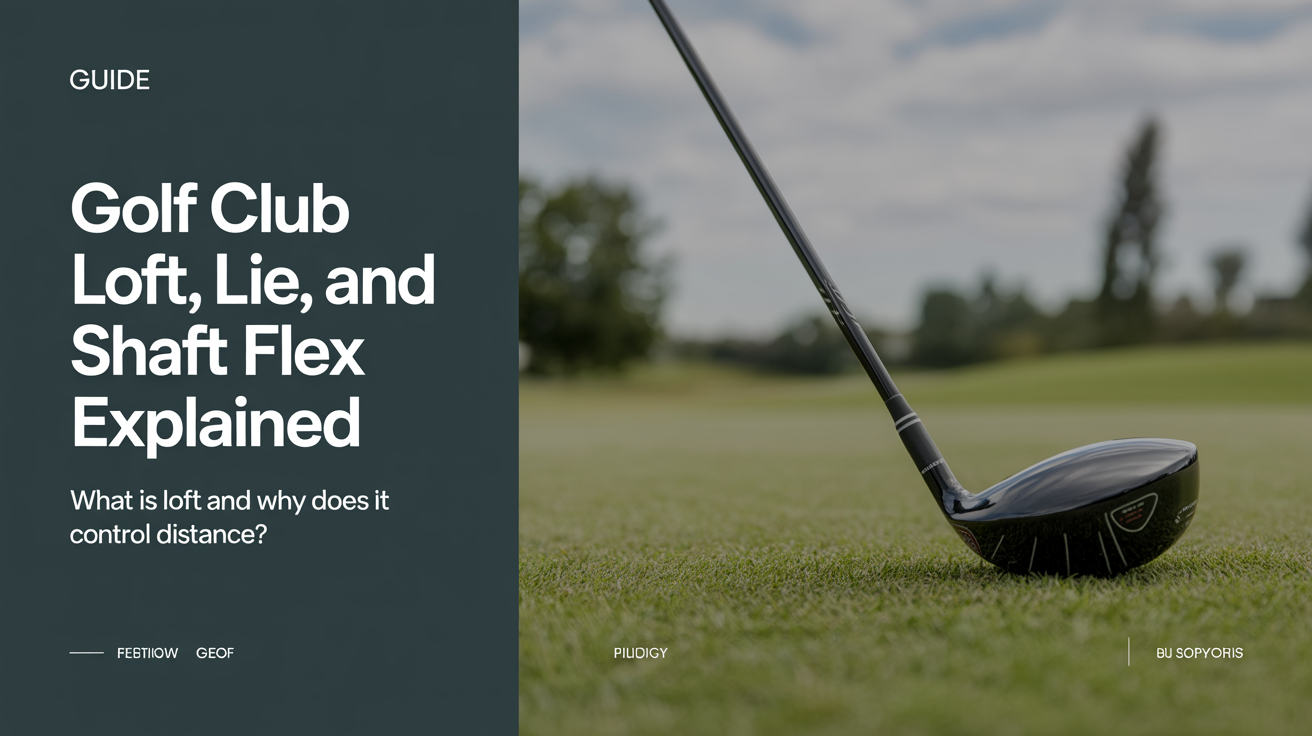
Loft is the angle of the clubface relative to vertical. A driver has very little loft, somewhere around 9 to 12 degrees, which launches the ball low and lets it roll out after landing. A pitching wedge has much more loft, typically 44 to 48 degrees, which sends the ball high and lands it softly with less roll. Wikipedia's overview of golf club design describes loft the same way: the angle between the face and the vertical plane, where higher numbers produce a higher, shorter trajectory and lower numbers produce a lower, longer one.
Here is the basic rule: the higher the loft, the higher and shorter the shot. Lower loft means more distance but a lower ball flight.
That relationship is why a full set of 14 clubs covers a wide range of distances. Each club steps down in loft by a few degrees, which drops the carry distance by roughly 10 to 15 yards per club for an average golfer. The gaps are designed to work as a system, not as 14 unrelated tools.
Standard Loft Ranges by Club Type
| Club | Typical Loft Range |
|---|---|
| Driver | 9 to 12 degrees |
| 3-wood | 15 to 18 degrees |
| 5-hybrid | 25 to 27 degrees |
| 5-iron | 26 to 28 degrees |
| 7-iron | 32 to 35 degrees |
| Pitching wedge | 44 to 48 degrees |
| Sand wedge | 54 to 56 degrees |
| Lob wedge | 58 to 60 degrees |
Manufacturers adjust these numbers slightly between models, so the loft printed on a club matters more than the number stamped on the sole. Two "7-irons" from different brands can carry two or three degrees apart, which is enough to change your yardage gapping.
What Is Lie Angle and When Does It Matter?
Lie angle is the angle between the shaft and the ground when the club sits in its address position at the sole. Standard lie for a 7-iron is around 62 degrees, give or take a degree depending on the manufacturer.
When the lie angle is correct for your height and swing, the sole sits flat at impact. When it is off, the heel or toe digs in, which twists the face and sends shots left or right.
How Lie Affects Ball Direction
- Too upright (heel down at impact): the face points left at contact, shots tend to pull left for a right-handed golfer
- Too flat (toe down at impact): the face points right, shots tend to push right
For most beginners, standard lie clubs work fine. The adjustment becomes useful once your swing is consistent enough that you keep missing in the same direction without an obvious cause. A fitter can check lie angle quickly with a board test or impact tape, and most club brands allow bending irons plus or minus two or three degrees.
If you are unusually tall or short, or have a swing plane that is particularly upright or flat, a lie adjustment can help. Otherwise, it is not something to stress over early on. Bending two degrees on a 7-iron moves your typical miss by only a few yards left or right at 150 yards, which is a small fix compared to what a swing change would do for the same miss pattern.
Shaft Flex Explained
The shaft is the engine of the club. Its flex rating tells you how much it bends during the swing, which affects both timing and launch angle. A 2012 biomechanics study on golf shaft stiffness measured this directly: golfers hitting drives with shafts that varied only in bending stiffness showed measurable changes in clubhead presentation and wrist kinematics at impact, meaning flex is not just marketing language, it changes how the club actually arrives at the ball.
Flex categories run from softest to firmest:
- L (Ladies) for slower swing speeds, typically under 60 mph with a driver
- A (Senior or Amateur) for 60 to 75 mph
- R (Regular) for 75 to 90 mph, the most common choice for recreational golfers
- S (Stiff) for 90 to 105 mph
- X (Extra Stiff) for 105 mph and above
These are guidelines, not hard rules. Shaft companies each set their own standards, so an "R" from one brand may play softer or stiffer than an "R" from another.
Regular vs Stiff Shaft for Beginners
Most beginners fall into the regular flex category. If you are just starting out and your driver swing speed is below 90 mph, a regular shaft will load and release correctly for your tempo. A shaft that is too stiff for your speed will feel boardy, cost you distance, and tend to produce shots that fly low and right (for right-handers).
The opposite problem, using a shaft that is too soft, causes the tip to lag and then kick through aggressively at impact. That produces inconsistent launches: sometimes high and left, sometimes the shaft spaghetti-bends and you lose control entirely.
The best approach for any beginner is to get a basic swing speed reading, which many shops provide for free with a launch monitor, then pick the flex that matches.
Swing Speed to Flex: A Quick Reference
| Driver Swing Speed | Typical Flex | Rough Carry Distance |
|---|---|---|
| Under 60 mph | L (Ladies) | Under 150 yards |
| 60 to 75 mph | A (Senior) | 150 to 190 yards |
| 75 to 90 mph | R (Regular) | 190 to 230 yards |
| 90 to 105 mph | S (Stiff) | 230 to 260 yards |
| 105 mph and up | X (Extra Stiff) | 260 yards and up |
Treat the carry-distance column as a rough sanity check, not a target. It exists to help you flag an obvious mismatch, like someone carrying the ball 180 yards insisting they need stiff shafts because a friend plays them.
What About Graphite vs Steel Shafts?
Shaft material is separate from flex but comes up in the same conversation.
Steel shafts are heavier, which helps with feel and control. They are standard in irons for mid-to-low handicap players and are less expensive.
Graphite shafts are lighter, which helps generate speed with less effort. They are almost universal in drivers and woods, and common in iron sets aimed at seniors, women, or players with slower swing speeds.
For most beginning golfers, graphite shafts in irons reduce fatigue on longer practice sessions and add a small amount of extra distance. Neither material is wrong. The weight difference, often 40 to 50 grams lighter in graphite versus steel for a comparable iron, is a bigger factor than the material label itself.
Putting It Together When Buying Clubs
When you are looking at your first set of clubs, here is a practical way to think through these specs:
- Loft: a beginner-friendly set will have higher-lofted irons (sometimes called game-improvement irons) and a driver in the 10 to 12 degree range, both of which make it easier to get the ball airborne
- Lie: standard lie works for the vast majority of players; revisit after six months if you are consistently pushing or pulling shots with no swing cause
- Shaft flex: match to your swing speed, and when in doubt lean toward regular rather than stiff
You do not need a custom fitting on day one, but knowing what these numbers mean lets you make a smarter decision off the rack. For more detail on how many clubs to carry when starting out, see how many golf clubs does a beginner actually need.
A PGA professional can assess your swing speed and lie angle correctly in a short session. That is worth doing before spending on a premium set, even if it is just a 20-minute check rather than a full custom fitting.
Frequently Asked Questions
Does loft matter on a driver or is it just preference?
Loft does matter, and most beginners benefit from more of it, not less. A 10.5 or 12 degree driver launches the ball higher, which maximizes carry distance for moderate swing speeds. The low-lofted drivers you see tour players use require very high clubhead speed and specific launch conditions to work well.
Can I bend the loft on my irons?
Forged irons can be bent a degree or two to adjust loft and lie. Cast irons vary by model. A club fitter or repair shop can tell you whether your specific heads are bendable and what adjustments are safe without stressing the hosel.
How do I know my swing speed without a launch monitor?
A rough indicator is carry distance with your driver. Under 200 yards of carry typically suggests a swing speed below 85 mph and points toward regular flex. If you are hitting close to 250 yards of carry, you are likely in the stiff range. A launch monitor reading from a local shop or range is more accurate and often free.
What is the difference between shaft flex and shaft weight?
Flex is how much the shaft bends during the swing. Weight is how heavy the shaft is, measured in grams. A regular flex shaft in a 65-gram weight plays very differently from a regular flex shaft in a 50-gram weight. Both numbers matter when fitting, though for a beginner the flex category is the more important starting point.
Do lie angle adjustments require a professional?
They do. Bending a hosel requires a loft and lie machine and some experience with how much stress the specific head can handle. Attempting it at home risks cracking the hosel. Any reputable golf shop can do it quickly and inexpensively, usually for a few dollars per club.
Will the wrong shaft flex actually hurt my scores, or is it a minor detail?
It is not minor. A mismatched flex changes your launch angle, spin, and dispersion on every full swing, which touches nearly every shot in a round. A too-stiff shaft tends to leave the face open at impact and knock distance off long shots; a too-soft shaft adds unpredictable spin and left misses. Getting flex roughly right does more for consistency than most equipment upgrades beginners spend money on.