How Many Golf Clubs Does a Beginner Actually Need?
Wondering how many golf clubs do I need to start? A beginner needs far fewer than the 14-club max. Here's the practical starter selection.
The short answer: way fewer than 14
The rules of golf allow a maximum of 14 clubs in your bag. Tour professionals carry exactly 14, each chosen for a specific distance gap or shot shape.
You are not a tour professional. You need about 7, maybe 8.
That is not a knock on your ability. It is practical advice. Beginners miss shots far more often from poor mechanics than from having the wrong club. Carrying a full set adds weight, decision fatigue, and expense, none of which help you improve faster. A tighter selection forces you to learn each club well, and that pays off quickly.
Why fewer clubs makes learning easier
Think about learning to drive. You did not start by practicing parallel parking on a steep hill during rush hour. You started somewhere simple.
Golf works the same way. When you only have one option for a medium distance shot, you swing it, you learn it, you improve. When you have four clubs that could all theoretically hit 150 yards, you stand over the ball paralyzed, pick one at random, and never develop a feel for any of them.
There is also the carry factor. A bag with 7 clubs weighs a lot less than one stuffed with 14. If you are walking the course, that matters by hole 12.
A sensible starter selection
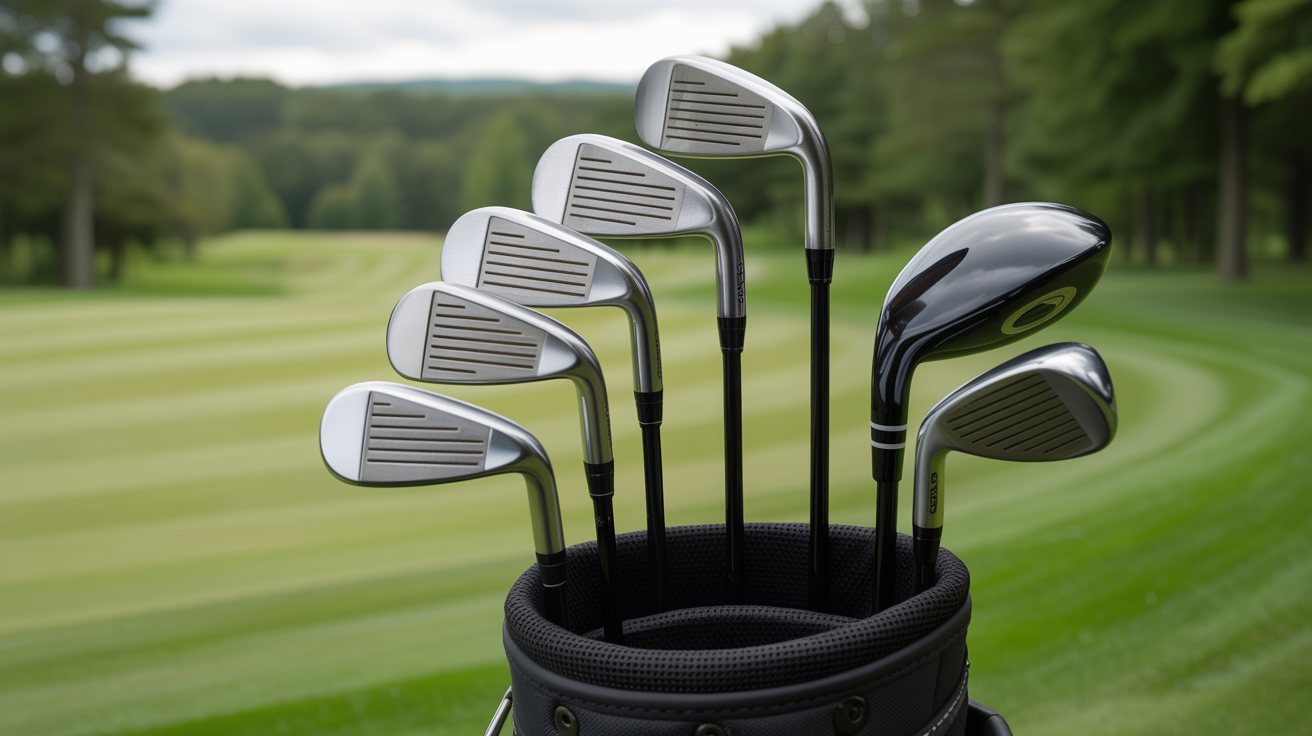
This is not the only way to build a beginner set, but it covers every situation you will encounter on a real course without overwhelming you.
| Club | Purpose |
|---|---|
| Driver (10.5° or higher) | Tee shots on par 4s and par 5s |
| Fairway wood or hybrid (5-wood or 4-hybrid) | Long shots from the fairway or rough |
| 6-iron | Mid-distance approach shots |
| 8-iron | Shorter approach shots |
| Pitching wedge | Shots around 100 yards and in |
| Sand wedge | Bunkers and short chips |
| Putter | Everything on the green |
Seven clubs. That covers the tee, the fairway, the green, and the sand. Anything you cannot reach with this set, you chip up, pitch up, or simply enjoy the extra walk.
If you want one more, a 9-iron slots in between the 8-iron and pitching wedge and fills a useful gap. Eight clubs is still far more manageable than 14.
Why skip the long irons?
Long irons, typically the 2, 3, and 4, are some of the hardest clubs in the bag to hit cleanly. They require precise contact and a swing speed most beginners do not yet have. Even many experienced recreational golfers have replaced them with hybrids, which launch higher and forgive off-center hits much better. If your starter kit comes with a 3 or 4 hybrid, use that instead. Leave the 3-iron on the shelf for now.
What about the gap wedge?
Gap wedges (around 50-52 degrees) are useful, but they fall between the pitching wedge and sand wedge in distance. Learn those two first. Once you know roughly how far each goes, you will figure out pretty quickly whether you need something in between.
For a full breakdown of what all the clubs in a standard bag do, the guide to what's in a golf bag and how the 14 clubs work walks through each one.
What to look for in a starter set
Most starter golf club sets sold at major retailers come with 9-12 clubs, a bag, and sometimes a few head covers. That is fine for beginners. You do not need to pick 7 individual clubs from scratch.
A few things worth checking:
- Shaft flex. Most adult beginners should start with a regular or senior flex shaft. Stiff shafts are for faster swing speeds. If you swing slow and use a stiff shaft, you will likely push or slice everything right.
- Cavity-back irons. These have a scooped-out back, which moves weight to the perimeter of the clubface. They are more forgiving than blades on mishits, which means most of your early shots will go further than they deserve.
- Driver loft. A 10.5-degree or higher driver launches the ball more easily than a 9-degree. Higher loft = easier to get airborne = more fun. Get the higher loft.
- Putter fit. Stand naturally, grip the putter, and make sure the shaft angle feels comfortable. This is one club where going to a store and holding a few is worth the trip.
For more guidance on picking your first equipment, the article on how to choose your first set of golf clubs covers what to prioritize and what you can safely ignore.
When to add more clubs
Most golfers stick with their starter set for at least a season before thinking about filling the bag. That is the right call. Adding clubs before you know your distances is guesswork.
Once you have played 20 or 30 rounds and you keep noticing specific gaps, that is the signal. Common examples:
- You consistently face shots that are too far for your pitching wedge but too close for your 8-iron. A 9-iron or gap wedge fixes that.
- You find your hybrid too difficult to hit off tight lies, and you would like more fairway wood options. Fair enough.
- You want to try a 5-iron after feeling confident with the 6.
The clubs you add should fill real gaps you have experienced, not theoretical gaps you read about. Budgeting gradually also makes sense, because golf equipment is not cheap. Buying used clubs from a reputable source is one of the better ways to expand your set without spending a lot. The guide on buying used golf clubs without getting burned explains what to check and what to avoid.
Frequently asked questions
Do beginners really need 14 clubs?
No. The 14-club rule is a maximum, not a target. You can play a legal round with 7 clubs, 4 clubs, or even 1 club if you want. Most beginners will improve faster with a smaller, well-chosen set because it forces them to learn each club properly instead of shuffling through a bag full of choices.
Can I use just irons to start?
Yes, and some beginners do. Irons are easier to control than a driver and easier to store than a full bag. The downside is distance, so a round with only irons will take longer on longer holes. If that does not bother you, starting with a 5-iron through pitching wedge, plus a putter, is a completely workable approach.
What is the minimum number of clubs I need to play a round?
Technically, you could play with just one club, though it would be a frustrating day on the long holes. A more realistic minimum that covers all situations: a mid-iron (7 or 8), a wedge for short shots and bunkers, and a putter. Three clubs. Add a driver or hybrid and you have something usable for most courses.
Is it worth buying a full 14-club set right away?
For most beginners, no. You will likely outgrow some clubs as your swing develops and your distances change. Starter sets of 9-12 clubs are usually the better value at the beginning. Once you have played for a year or two and know what you actually need, you can make smarter choices about filling the gaps.
Are women's starter sets different from men's?
The club types are the same, but women's sets typically have lighter shafts and higher loft on each club, which helps generate more height and distance at lower swing speeds. If you are shopping, look for sets specifically labeled for women rather than buying a standard set and assuming it will suit you. The shaft weight and flex are the main functional differences, not just the grip color.