What's in a Golf Bag? The 14 Clubs Explained
Confused about what clubs are in a golf bag? Here's a plain-English breakdown of all 14 types and what each one actually does.
The short answer
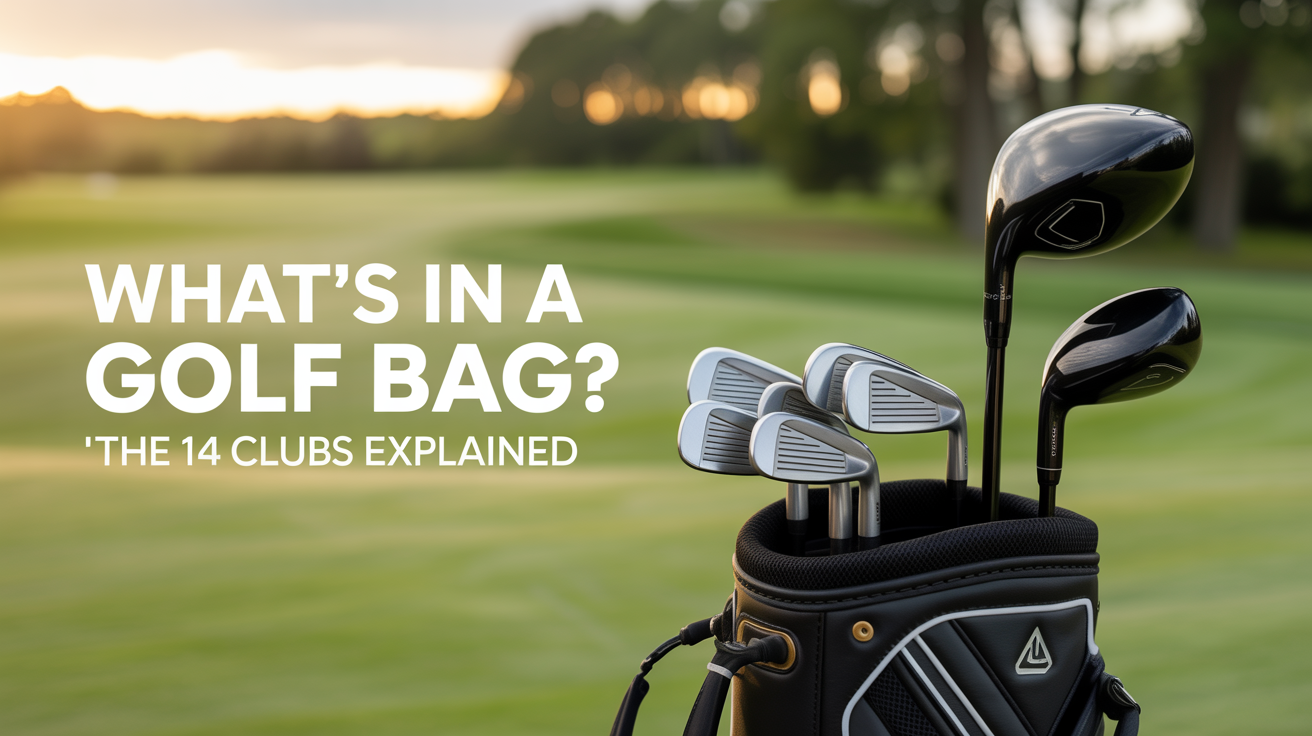
Rules allow up to 14 clubs in a bag. Those 14 slots are usually filled by a driver, a few fairway woods, a hybrid or two, a set of irons, a couple of wedges, and a putter. Each club does a different job, and knowing roughly what that job is will save you a lot of confusion out on the course.
Why 14? The rule behind the number
The USGA and R&A cap the number at 14 to keep the game from turning into an equipment arms race. In practice, most recreational players carry fewer than 14, and plenty of beginners do just fine with 7 or 8. The limit is a ceiling, not a requirement.
If you're still figuring out how many clubs you actually need to start, how many golf clubs does a beginner actually need walks through a practical starter setup without overwhelming you.
A look at every club type
The table below covers the standard club categories you'll see in most bags. Numbers and lofts are typical ranges, not locked-in specs, since manufacturers vary.
| Club | Typical loft | What it's for |
|---|---|---|
| Driver (1-wood) | 9-12 degrees | Maximum distance off the tee |
| 3-wood | 15-18 degrees | Long shots off the tee or fairway |
| 5-wood | 20-22 degrees | Fairway shots, slightly shorter than 3-wood |
| 3-hybrid | 19-21 degrees | Replaces long irons, easier to launch |
| 4-hybrid | 22-24 degrees | Same idea, a little shorter |
| 4-iron | 19-23 degrees | Long approach shots (advanced players) |
| 5-iron | 24-28 degrees | Mid-to-long approaches |
| 6-iron | 27-31 degrees | Mid-range approach shots |
| 7-iron | 31-35 degrees | One of the most-used clubs in the bag |
| 8-iron | 35-39 degrees | Shorter approach shots |
| 9-iron | 39-43 degrees | Close approach shots, around 100-130 yards |
| Pitching wedge (PW) | 44-48 degrees | Short approaches, chip shots |
| Sand wedge (SW) | 54-58 degrees | Bunker shots, short chips |
| Putter | 2-4 degrees | Rolling the ball on the green |
Not every bag looks like this. Many beginners swap out the long irons (3, 4, 5) for hybrids because hybrids are much more forgiving. Some players carry a gap wedge or lob wedge instead of a long iron. The exact mix is up to you.
Breaking it down by category
Woods
The driver, or 1-wood, is the biggest club in the bag with the largest head. It's designed for one thing: distance. You tee the ball up high and swing with a shallower angle to catch it on the upswing. Most beginners find the driver the hardest club to control, which is completely normal.
Fairway woods (3-wood, 5-wood) have smaller heads and a bit more loft. You can hit them off a tee or sweep them off the fairway when you need distance without using the driver.
Hybrids
Hybrids are the best thing to happen to recreational golf. They combine a wood-style head with an iron-length shaft, which makes it much easier to get the ball in the air compared to a long iron. If you're putting together a starter set, hybrids in place of the 3- and 4-iron (or even 5-iron) is a smart call. Choosing your first set of golf clubs goes into more detail on this.
Irons
Irons are numbered 3 through 9. Lower numbers mean lower loft and longer distance; higher numbers mean more loft, more height, and shorter distance. The 7-iron is a good all-around club that most beginners learn on first.
Irons are used mainly for approach shots, meaning shots from the fairway (or rough) toward the green. At shorter distances, they're also useful for punch shots or getting out of trouble.
Wedges
Wedges are high-lofted irons built for the short game. Most bags carry at least two:
- Pitching wedge (PW): Your go-to for shots inside 100-120 yards and for chipping near the green.
- Sand wedge (SW): Specifically designed with extra bounce on the sole to glide through bunker sand. Also handy for flop shots around the green.
More experienced players add a gap wedge (between the PW and SW) and sometimes a lob wedge (60 degrees or more) for very short, high shots. As a beginner, two wedges is enough.
The putter
Every bag has one putter. It's used exclusively on and around the green to roll the ball into the hole. Putting accounts for roughly 40 percent of the strokes in a typical round, so it's worth spending time on. Putters come in blade, mallet, and mid-mallet styles. If you're buying used, try a few different shapes and go with whatever feels most natural.
How a typical bag is set up
A standard 14-club setup might look like this:
- Driver
- 3-wood
- 5-wood (or 3-hybrid)
- 4-hybrid
- 5-iron
- 6-iron
- 7-iron
- 8-iron
- 9-iron
- Pitching wedge
- Gap wedge
- Sand wedge
- Lob wedge
- Putter
That's one way to fill the bag. A beginner might cut the woods to just the driver, skip the lob wedge, and add an extra hybrid instead. There's no single right answer.
If you're shopping for clubs and worried about getting ripped off, buying used golf clubs without getting burned has some useful guidance on what to look for and what to avoid.
A note on safety
Swinging a club generates real speed and force. Always check that nobody is standing within range before you swing, on the range or on the course. Shout "fore!" loudly if your ball heads toward other players. Warm up your shoulders and back before a round, especially if you haven't played in a while.
Frequently asked questions
Do I need all 14 clubs as a beginner?
No. Most beginners do fine with 7 to 10 clubs. A driver, a 3-wood or hybrid, a 7-iron, a 9-iron, a pitching wedge, a sand wedge, and a putter will cover the vast majority of situations you'll face. You can always add clubs as your game develops.
What's the difference between a wood and a hybrid?
Woods have larger hollow heads (originally made of wood, now metal) and are designed for maximum distance. Hybrids are smaller, more compact, and easier to hit cleanly, especially off the turf. Most beginners find hybrids far more manageable than low-number irons or fairway woods.
What does loft actually mean?
Loft is the angle of the clubface. A higher loft angle sends the ball higher into the air and over a shorter distance. A lower loft means the ball stays lower and travels farther. A driver might have 10 degrees of loft; a sand wedge might have 56 degrees.
Can I have more than 14 clubs?
No. Carrying more than 14 clubs during a round is a rules violation. The penalty in stroke play is two strokes per hole where the breach occurred, up to a maximum of four strokes per round. In match play, you lose the hole. It's an easy mistake to avoid: just count your clubs before you tee off.
Which club should a beginner practice with first?
The 7-iron is the standard answer, and it's good advice. It's not too long, not too short, and has enough loft to get the ball airborne without requiring a perfect swing. Once you're making decent contact with a 7-iron, the rest of the bag starts to make more sense.