Driver, Irons, Wedges, and Hybrids: What Each Club Does
A plain-English guide to golf club types explained: what drivers, irons, wedges, and hybrids do and when to reach for each one.
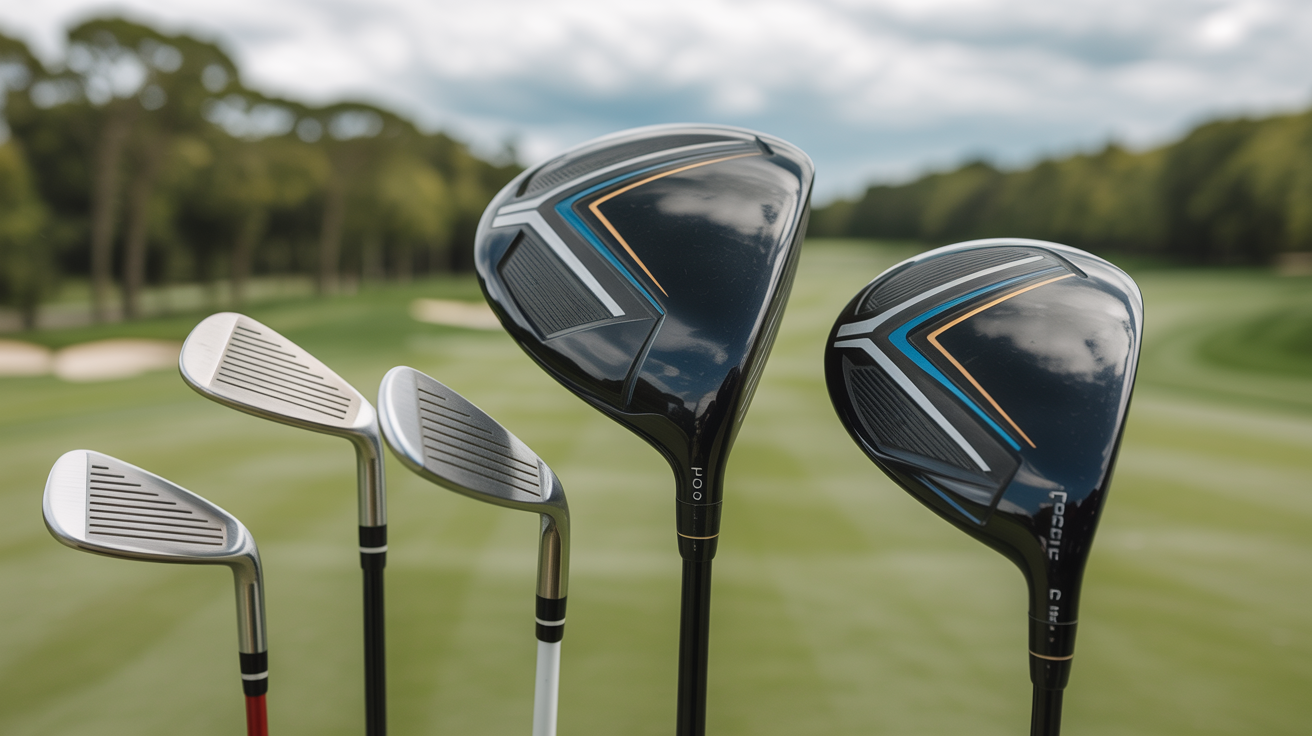
Golf bags can look overwhelming at first glance. Fourteen clubs, each shaped differently, numbered inconsistently, and given names that hint at nothing about their purpose. This guide cuts through that confusion. Below you will find a plain description of every major club type, what it is designed to do, and when you would actually pull it from the bag.
The Driver: Your Longest Club
The driver (also labeled the 1-wood) is the club you use from the tee on longer holes. Its defining features are a large, hollow clubhead and a long shaft. Both are there for the same reason: they let you swing the club fast and launch the ball high so it travels as far as possible.
For beginners, the driver is often the hardest club to control. The combination of a long shaft and a face that is meant to be hit near the top of the arc makes it unforgiving of small mistakes in timing. Many new golfers get more distance and accuracy from a 3-wood or 5-wood off the tee until their swing becomes more consistent.
When to use it: Off the tee on par 4s and par 5s where distance is the priority over accuracy.
What to look for as a beginner: A driver with 10.5 to 12 degrees of loft. More loft helps get the ball airborne and reduces the spin that causes shots to curve sideways.
Irons: Your Workhorse Clubs
Irons cover the middle distances of the game. They are numbered from 1 to 9, and that number tells you two things: loft and expected distance. A lower number means less loft and more distance; a higher number means more loft and a shorter, higher shot.
Most beginner sets include irons from the 5 or 6 through the 9, plus a pitching wedge. Long irons (1 through 4) are notoriously difficult to hit and have largely been replaced by hybrids and fairway woods in recreational play.
How to read the numbers
- 5-iron and 6-iron: Mid-range shots from the fairway, roughly 150 to 180 yards for most beginners.
- 7-iron and 8-iron: Shorter approach shots, often 120 to 150 yards. These are the most commonly hit irons in a round and excellent clubs for practicing your swing.
- 9-iron: High, soft shots from around 100 to 130 yards. The extra loft helps the ball land and stop quickly on the green.
When to use irons: Approach shots from the fairway, shots from the rough at moderate distances, and any situation where you need the ball to stop reasonably close to where it lands.
Wedges: Precision Around the Green
Wedges are high-lofted irons built for short, accurate shots. Their job is to get the ball up quickly and bring it down softly. There are four main types:
| Wedge | Loft Range | Primary Use |
|---|---|---|
| Pitching Wedge (PW) | 44 to 48 degrees | Full shots from 80 to 120 yards |
| Gap Wedge (GW) | 50 to 54 degrees | Fills the distance gap between PW and SW |
| Sand Wedge (SW) | 54 to 58 degrees | Bunker shots; also chips and pitches |
| Lob Wedge (LW) | 58 to 64 degrees | Very high, short shots over obstacles |
For a beginner, the pitching wedge and sand wedge cover most situations. The gap wedge becomes useful once you have a clearer sense of your own distances. The lob wedge is harder to control and is usually added later.
When to use wedges: Shots inside 100 yards, greenside chips and pitches, and bunker escapes. The sand wedge's wide sole is specifically shaped to slide under the ball in soft sand rather than digging in.
Hybrids: The Problem Solvers
Hybrids are exactly what the name suggests: a cross between a fairway wood and a long iron. They have a rounded head like a small wood but produce a trajectory and distance similar to the long irons they typically replace.
The reason hybrids became so common is simple. Long irons (2, 3, and 4) require a fast, precise swing to generate enough height and distance. Hybrids are much more forgiving because the low center of gravity helps launch the ball even on off-center hits.
If you see a club in a beginner set labeled H4 or 4H, that is a hybrid meant to replace a 4-iron.
When to use hybrids: Fairway shots at longer distances (170 to 210 yards for most beginners), difficult lies in the rough where an iron would dig in, and any distance range where you struggled with long irons.
Irons vs. hybrids at the same distance: Hybrids tend to produce a higher ball flight and are easier to hit from rough. Irons give more control and a lower, more penetrating trajectory, which can be useful in windy conditions. As a beginner, lean toward the hybrid until your ball-striking is consistent.
Fairway Woods: Distance Without the Driver
Fairway woods (3-wood, 5-wood, 7-wood) sit between the driver and hybrids in terms of distance. Their clubheads are smaller than a driver but still hollow and rounded.
The 3-wood is a versatile option off the tee on tight holes where you need more accuracy than the driver provides. It also works from the fairway on long par 5s. The 5-wood and 7-wood are similar to hybrids in use but tend to produce slightly more distance.
When to use fairway woods: Long second shots on par 5s, tee shots on shorter par 4s where accuracy matters more than distance, and any shot where you need the ball to travel more than 180 to 200 yards from the fairway.
A Quick Reference: Which Club for Which Shot
- Tee on a long hole: Driver or 3-wood
- Fairway, long distance: 3-wood, hybrid, or 5-iron
- Fairway, mid distance: 5 through 7-iron
- Approach to the green, short distance: 8-iron, 9-iron, or pitching wedge
- Inside 100 yards: Sand wedge, gap wedge, or pitching wedge depending on distance
- Bunker: Sand wedge
- Short chip around the green: Pitching wedge or 7-iron (for a low running chip)
If you are just putting together your first bag, the what's in a golf bag guide covers how a full set fits together. For help deciding what to actually buy, see how to choose your first set of golf clubs and how many clubs a beginner actually needs.
The Fairway Primer is an independent resource and is not affiliated with any equipment brand. Consult a PGA professional for personalized instruction.
Frequently Asked Questions
What is the difference between a wedge and an iron? Wedges are a subset of irons, but they have much higher loft angles (typically 44 to 64 degrees). Standard irons go from about 20 degrees of loft at the low end up to around 44 degrees. The extra loft on wedges means the ball launches higher and lands more steeply, which helps it stop near where it lands instead of rolling forward.
When should a beginner use a hybrid instead of a long iron? Most beginners are better served by a hybrid any time they would otherwise reach for a 3, 4, or 5-iron. Hybrids are more forgiving on off-center contact and easier to get airborne from the fairway and rough. Once your ball-striking is consistent, you can experiment with long irons and decide which you prefer.
Do beginners need all four wedge types? No. A pitching wedge and a sand wedge cover the majority of situations for a new golfer. Add a gap wedge when you notice a distance gap you cannot comfortably fill with either of those two. The lob wedge is worth exploring after you have solid fundamentals around the green.
Can I use a 7-iron for a chip shot near the green? Yes. A 7-iron chip (also called a bump-and-run) is a reliable shot for beginners because it keeps the ball low and rolling like a putt for most of its journey. It works well when there is short grass between you and the hole with no bunker or slope to carry. Many coaches teach it before introducing the pitching wedge chip precisely because it requires less precise contact.
What does "loft" mean and why does it matter? Loft is the angle of the clubface relative to vertical. A driver might have 10 degrees of loft; a lob wedge might have 62 degrees. More loft sends the ball higher into the air and, as a result, shorter distances for the same swing speed. When you move from a low-numbered iron to a high-numbered one, you are increasing loft, which is why a 9-iron goes higher and shorter than a 5-iron.