Tempo and Balance: How to Swing Smoother, Not Harder
Learn how golf swing tempo and balance work together to help beginners hit cleaner, more consistent shots without swinging harder.
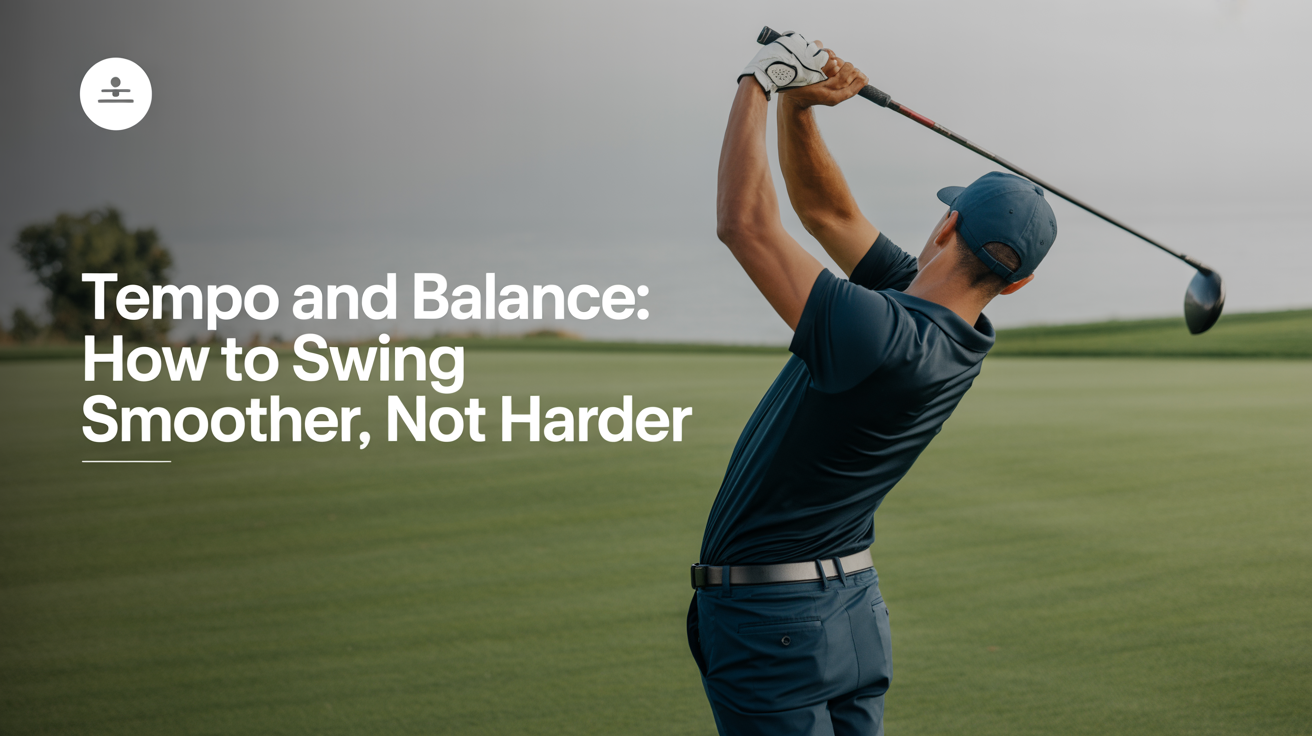
Most beginners assume distance comes from swinging harder. It does not. It comes from swinging in rhythm, staying balanced, and making solid contact. Golfers who learn to control their tempo early tend to improve faster than those who keep chasing speed. This guide breaks down what tempo means in a golf swing, how balance connects to it, and what you can actually do to develop both.
What Golf Swing Tempo Actually Means
Tempo is the overall pace and rhythm of your swing from start to finish. It is not just the speed at which the clubhead travels. It describes the relationship between your backswing and downswing, and how smoothly one transitions into the other.
A common ratio used by instructors is 3:1. Your backswing should take roughly three times as long as your downswing. So if you take 0.75 seconds to reach the top, your downswing should take about 0.25 seconds. The actual speed varies by player, but that ratio tends to hold across most skill levels.
What goes wrong for beginners is usually a jerky transition. The backswing starts slow, then there is a sudden lunge at the ball. That abrupt change in tempo throws off the clubface angle, disrupts your sequencing, and costs you accuracy and power both.
Good tempo does not feel slow. It feels controlled. A well-timed swing often feels easier than a forced one, and the ball goes farther because the energy transfer is cleaner.
Why Balance Matters as Much as Tempo
Balance and tempo are connected. When your swing loses balance, it is almost always because the tempo broke down somewhere first.
A common example: you rush the transition, your weight gets stuck on your back foot, and you "hang back" through impact. The result is a thin or topped shot. Or you lunge forward too early and your upper body gets ahead of the ball, leading to a pull or a fat contact.
Good balance in the golf swing means your weight moves smoothly from a centered setup to the inside of your back foot during the backswing, and then fully onto your front foot by the time you finish. At the end of a balanced swing, you should be able to hold your finish position comfortably for two full seconds without wobbling.
If you cannot hold your finish, something earlier in the swing broke down. Either the tempo was off, or the swing path was so steep or flat that recovery was the only option.
A Simple Balance Check
Stand in your address position and try to feel your weight distributed roughly evenly across both feet, with a slight bias toward the balls of your feet rather than your heels or toes. From there, take slow practice swings without a ball and focus entirely on finishing upright on your front foot, belt buckle facing the target. Do this ten times before each practice session and you will start to notice when your balance slips mid-swing.
How to Actually Slow Down Your Golf Swing
Slowing down does not mean swinging weak. It means giving each part of the swing time to complete before the next part begins.
A few things that help:
- Take a full backswing. Rushing usually means cutting the backswing short. When you let the club reach the top naturally, there is a built-in pause that resets your rhythm.
- Start the downswing with your lower body, not your arms. The transition from backswing to downswing is where most tempo breaks happen. Beginners tend to throw the club from the top with their hands. Instead, let your hips begin to shift and rotate first, and let the arms follow.
- Count "one" on the way back and "two" at the finish. This old practice drill works because it forces you to assign equal attention to both halves of the swing. Say it out loud if it helps.
- Practice with a shorter club. Tempo problems are harder to see with a driver. Hit punch shots with a 7-iron at 70 percent effort and notice how much more controlled your contact feels. Then build back up to full swings.
If you have not yet worked on the foundation of your swing, grip and posture play a major role in how smoothly you can move. See How to Grip a Golf Club: The Foundation of a Good Swing for a solid starting point.
Common Tempo and Balance Problems for Beginners
| Problem | Likely Cause | Quick Fix |
|---|---|---|
| Topping the ball | Hanging back, weight on rear foot | Check finish position; front foot should bear your weight |
| Fat contact (hitting behind ball) | Lunging forward early | Pause at the top; let hips lead the downswing |
| Pulled shots (ball goes left) | Arms racing ahead of body | Start downswing with lower body rotation |
| Thin contact on irons | Rushing the backswing | Count "one" going back to force a complete turn |
| Loss of balance at finish | Overswinging at the top | Reduce backswing length until balance holds |
Most of these connect back to one issue: the transition. That moment at the top of the backswing is where tempo and balance are either preserved or lost.
Drills to Build Smoother Tempo
The Feet-Together Drill
Hit short shots with your feet touching. When your feet are that close together, an off-balance swing sends you stumbling immediately. This drill teaches your body to self-correct. Use a 7-iron, swing at half speed, and focus on staying centered. Move your feet back to normal width when you can make clean contact five times in a row.
The Grip-Down Drill
Choke down two inches on any iron and swing at 70 percent effort. The shorter effective length of the club rewards tempo over force. When this feels smooth, gradually move your grip back up.
Slow-Motion Swings
Take three slow-motion practice swings before every shot on the range, not just a quick waggle. Move the club deliberately through the entire motion, pausing at the top for a full second. This resets your nervous system before you apply any speed.
For reference on what a complete beginner swing looks like from setup to finish, How to Swing a Golf Club: A Step-by-Step Beginner Guide walks through each piece.
Putting It Together on the Range
Tempo and balance are habits, not tricks. They develop through repetition at lower intensity before they hold up under pressure.
Spend the first ten minutes of any range session hitting half-speed shots with a mid-iron. Focus on finishing balanced, not on where the ball goes. When your balance holds across several consecutive swings, increase to three-quarter speed. Only then move to full effort.
You will likely find that three-quarter speed produces results close to what you were getting at full effort, because the contact quality improves. That is the point. A smooth swing that finds the center of the clubface every time is more effective than a fast swing that misses by half an inch.
Also pay attention to your stance width and posture before each swing. A stance that is too narrow or too wide throws off your weight transfer from the start. Golf Stance, Posture, and Ball Position for Beginners covers how to dial those in.
Frequently Asked Questions
How slow should my backswing be?
There is no single correct speed. The goal is consistency and a 3:1 ratio between backswing and downswing duration. Most amateur golfers naturally rush their backswing, so consciously slowing it feels exaggerated at first. That feeling is usually a sign you are on the right track.
Should I feel any pause at the top of my swing?
Yes, briefly. There is a natural transition point where the backswing ends and the downswing begins. Letting that moment exist, rather than forcing an immediate reversal, helps your lower body get ahead of your arms and improves sequencing. It is a fraction of a second, not a real stop.
Why do I hit better shots when I am not trying as hard?
This happens because reduced effort allows your tempo to stay intact. When you swing at 100 percent effort, small timing errors get amplified. At 80 percent, your contact point improves, and the swing path straightens out. Most golfers find a "strong 80 percent" produces longer and straighter shots than a forced 100 percent.
Does tempo change for different clubs?
The rhythm should feel similar across clubs, but longer clubs naturally take more time to swing. The 3:1 ratio holds throughout. You do not need to consciously adjust your tempo for each club; focus on the same smooth rhythm and the swing will adjust around the club's natural length.
How long does it take to develop consistent tempo?
Expect four to eight weeks of regular practice before tempo starts to feel automatic. The key is deliberate repetition at lower speeds before pushing toward full effort. Once your body has a reliable rhythm at 70 percent, it becomes much easier to maintain under pressure.