How to Grip a Golf Club: The Foundation of a Good Swing
Learn how to grip a golf club correctly with this beginner's guide. Covers all three grip styles, pressure, hand placement, and common mistakes.
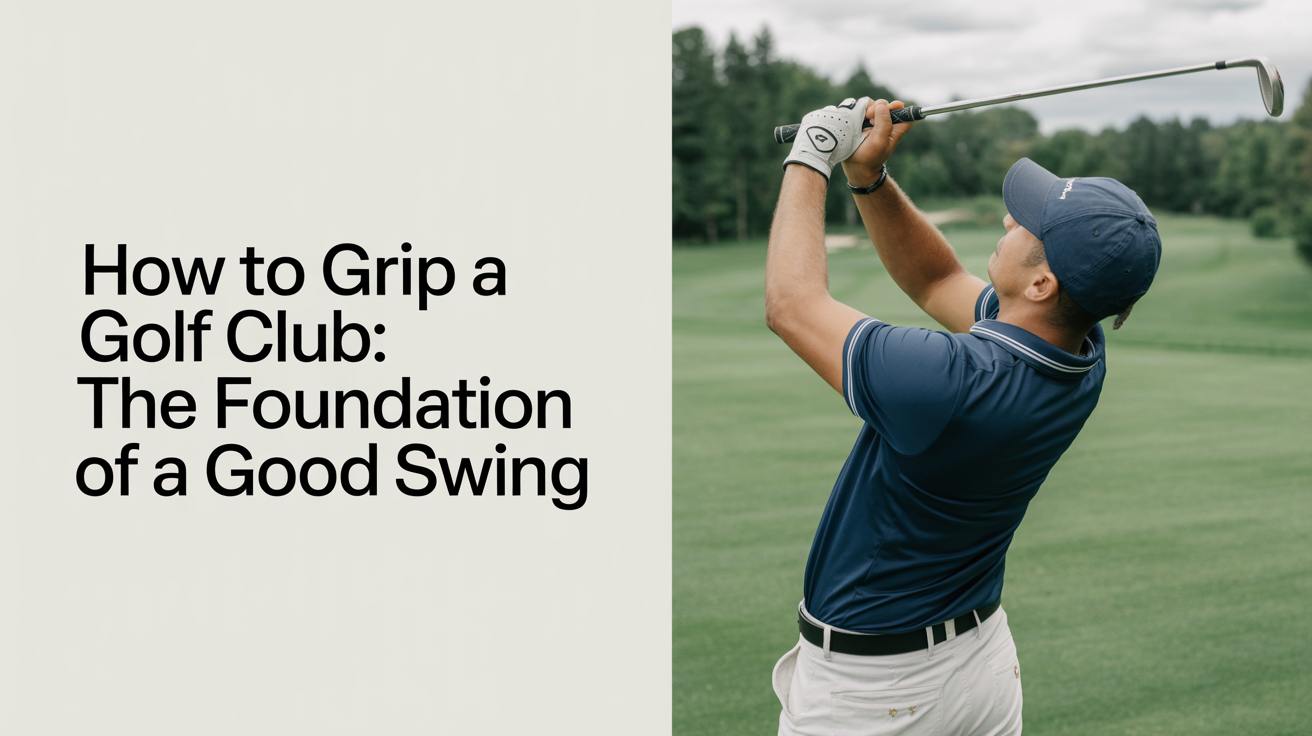
Your grip is the only contact point between you and the club. Get it reasonably right and everything downstream gets easier. Get it wrong and you're fighting the club on every shot before the swing even starts.
Why the grip matters more than you think
Most beginners focus on the swing, the stance, or buying better clubs. The grip gets overlooked because it feels awkward to change and nobody can see it in a photo of a finished swing. But the grip quietly controls two things that matter enormously: clubface angle at impact, and how freely your wrists can hinge and release through the shot.
A grip that's too strong (hands rotated too far to the right for a right-handed golfer) tends to close the face and produce pulls or hooks. A grip that's too weak (hands rotated too far left) opens the face and promotes the slice that plagues so many new players. If you've already started wondering why you curve the ball so much to the right, the real reasons behind a slice trace back partly to this.
So before you worry too much about hip rotation or weight transfer, spend ten minutes getting a neutral grip dialed in. It's the single highest-leverage thing a beginner can do.
How to place your hands on the club
Start with a mid-iron, like a 7-iron. It's long enough to swing but forgiving enough to practice with.
The lead hand (left hand for right-handers)
Set the club on the ground in front of you, face square. Pick it up with your left hand so the grip runs diagonally across your fingers, not across your palm. The grip should sit from the base of your index finger across to just above the pad of your pinky. When you close your hand, two to two-and-a-half knuckles should be visible when you look down. That's a neutral position.
The "V" formed between your thumb and index finger should point toward your right shoulder (your trail shoulder). This is the checkpoint most instructors use. One knuckle visible means a weak grip. Three or four knuckles means strong. Neither is wrong in all situations, but neutral is the safest starting point.
The trail hand (right hand for right-handers)
Position your right hand just below the left, with the palm facing the target. The grip sits more in the fingers here than across the palm. Your right thumb and index finger form another "V", and that too should point roughly toward your right shoulder.
The pad of your right thumb should sit on top of the left thumb. This connection between the two thumbs is what keeps the hands working as a unit rather than fighting each other.
The three grip styles
Here's where beginners often get confused: there isn't one single correct way to connect your hands. There are three main options, and each has genuine pros and cons.
The ten-finger grip (also called the baseball grip)
All ten fingers contact the grip with no overlap or interlock. The right pinky sits next to the left index finger instead of on top of or interlocked with it. This is the easiest to learn and the most natural for people with smaller hands, arthritis, or limited finger strength. Junior golfers often start here.
The downside is that the hands can work independently if your grip loosens, which reduces consistency. But if the other styles feel impossible, don't let anyone talk you out of this one. Some tour players have used it successfully.
The overlap grip (Vardon grip)
The right pinky rests on top of, or in the groove between, the left index and middle fingers. This is the most common grip among adult recreational golfers and was popularized by Harry Vardon over a century ago. It keeps the hands connected without forcing the fingers into an awkward position. Recommended starting point for most adults with average-sized hands.
The interlock grip
The right pinky and left index finger literally interlock, fingers weaving together. Tiger Woods and Jack Nicklaus both used this. It creates a very unified feel and works well for players with smaller hands who feel like the overlap doesn't quite hold together. The trade-off is that it can feel tighter and take longer to get comfortable.
Quick comparison:
| Grip style | Best for | Main advantage | Main drawback |
|---|---|---|---|
| Ten-finger | Beginners, small hands, arthritis | Easy, natural | Hands can separate |
| Overlap | Most adult beginners | Good balance of unity and comfort | Can feel loose with small hands |
| Interlock | Smaller hands, strong preference for unity | Very connected feel | Can feel rigid at first |
There's no ranking. Try each one, hit some balls, and stick with whichever feels most consistent. Don't switch mid-round once you've picked one.
Getting grip pressure right
This is where most beginners quietly go wrong. They grip the club like they're trying to keep it from flying into the crowd. That tension travels up the arms, locks the shoulders, and kills clubhead speed before the swing starts.
Target a grip pressure of about 4 to 5 out of 10. Firm enough that the club won't twist at impact. Loose enough that your forearms stay relaxed. A useful reference: hold the club as firmly as you'd hold a tube of toothpaste without squirting any out.
Pressure should be primarily in the last three fingers of the lead hand. The trail hand supports but shouldn't dominate. Through the swing, pressure naturally increases slightly at impact, but if you start tight it compounds into a stranglehold by the time you reach the ball.
Check your grip pressure during your pre-shot routine, not mid-backswing. Once the club is in motion, trying to adjust tension introduces more problems than it solves.
Common grip mistakes beginners make
Gripping in the palm of the lead hand. When the grip runs across the palm rather than the fingers, the wrist can't hinge properly. The result is a stiff, armsy swing with almost no power. Check that diagonal finger placement before every session.
Thumbs pointing straight down the shaft. Long thumbs pointing directly down the grip (called "long thumbs") can cause the wrists to hinge early and break down. A slightly shorter position, with the thumb bent down and to the side, is more stable.
Re-gripping at the top of the backswing. Some beginners unconsciously loosen and re-grip at the top. This is usually a sign of too much tension to start. Lighten up at address and the re-grip tends to disappear.
Dominant hand taking over. Right-handed golfers sometimes let the right hand push through the shot, which flips the face closed and causes hooks. If you're fighting low pull-hooks, try softening your right-hand pressure specifically.
Once your grip is in better shape, revisit how you're standing to the ball. The grip and stance feed each other; fixing one often makes the other click.
Practicing your grip off the course
You don't need a range session to groove your grip. Here's what actually helps:
- Grip rehearsal at home. Pick up a club and check your hand position in a mirror before bed. Five minutes a night builds muscle memory faster than an hour on the range with a bad grip.
- Grip tape on a spare club. Some teachers use whittled pencils or grip aids to help students feel the correct finger placement. Not necessary, but useful if you keep slipping into a palm grip.
- Film yourself from above. A phone propped up on a bag aimed straight down at your hands shows knuckle count clearly. Two to two-and-a-half from above, V's pointing to the trail shoulder.
- Neutral grip, then adjust. Start neutral and only experiment with stronger or weaker positions once you understand what neutral feels like.
As your grip improves, you'll find the rest of your swing mechanics start to simplify. Less compensating, more consistent contact.
Frequently asked questions
Does it matter which grip style I use?
Not as much as getting your hand position and pressure right within whichever style you choose. The overlap is the most common starting point for adult beginners, but there's no penalty for using the ten-finger grip if it feels better. Pick one and stick with it long enough to actually evaluate it.
How do I know if my grip is too strong or too weak?
Too strong: you see three or more knuckles on your lead hand at address and tend to hook or pull shots. Too weak: you see only one knuckle and slice consistently to the right. Two to two-and-a-half knuckles with both V's pointing to your trail shoulder is neutral, and that's where most beginners should start.
My hands hurt after gripping. What am I doing wrong?
Usually two culprits: gripping too tightly, or gripping in the palm rather than the fingers. Both create friction and tension. Check your pressure (aim for a 4-5 out of 10) and make sure the grip is sitting diagonally across the fingers of your lead hand. If discomfort continues, a teaching professional can check for grip size, which also matters. Undersized grips cause you to squeeze harder.
Should my grip change for different clubs?
The fundamentals stay the same across all clubs. Some players make tiny adjustments for driver versus wedge, but those are advanced tweaks. For now, use the same neutral grip from a 3-wood to a sand wedge. Consistency is worth more than optimization at this stage.
How long does it take to feel comfortable with a new grip?
Honest answer: two to four weeks of regular practice before it stops feeling foreign. A month before it feels natural. That's normal. Your old grip, however wrong it was, has years of repetition behind it. Don't give up on a correct grip after one range session because it feels awkward. That awkwardness is just unfamiliarity.