Reading the Course: Hazards, Out of Bounds, and Penalty Areas
Learn golf hazards explained simply: what penalty areas and OB mean, how stroke-and-distance works, and how to keep moving without confusion.
Golf courses are designed with trouble built in. Ponds, creeks, dense rough, and fences are not accidents. They are there to make you think before you swing. Understanding what each type of hazard means, what it costs you, and what your options are will take a lot of the anxiety out of your first few rounds.
Here is a plain-language breakdown of golf hazards explained for players who are still learning the game.
At a Glance
- Penalty areas (red or yellow stakes) cost one stroke and let you drop outside the area instead of replaying the shot.
- Out of bounds (white stakes) is the expensive one: replay from the original spot under stroke and distance, adding two strokes total to your count, not one.
- Red stakes add a lateral drop option within two club-lengths; yellow stakes do not.
- Bunkers are not penalty areas. Play the ball as it lies and never ground your club in the sand before the swing.
- Unplayable lies can be declared almost anywhere except in a penalty area, for one penalty stroke and a choice of three drop options.
- A provisional ball saves a long walk back to the tee when you are not sure whether a shot is out of bounds.
The Difference Between Penalty Areas, Out of Bounds, and General Hazards
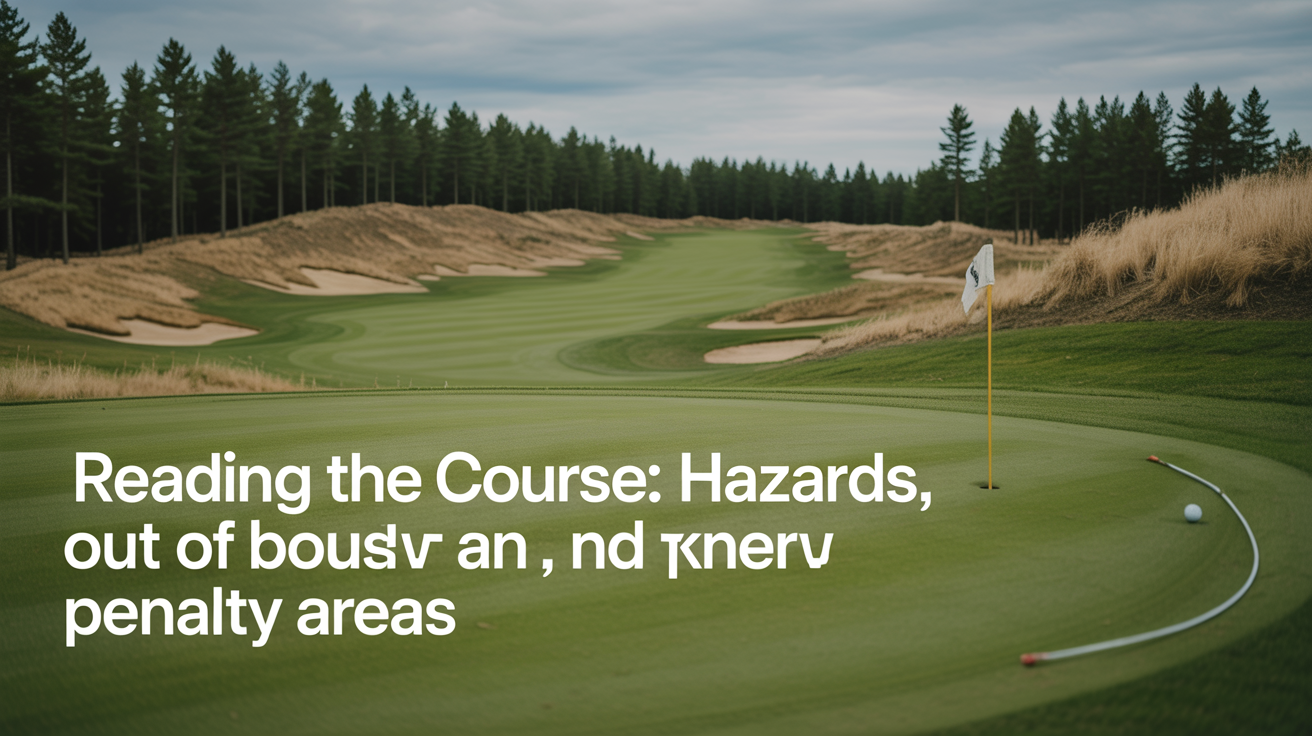
The rulebook divides trouble into a few distinct categories, and each one has a different consequence.
Penalty areas (marked with red or yellow stakes or lines) are places where you are allowed to drop outside the area with a one-stroke penalty. These used to be called "water hazards," but the modern rules expanded the definition so courses can mark any difficult terrain, not just water, as a penalty area. As Wikipedia's glossary of golf terms puts it, "penalty area" has been the official term since the 2019 rules revision, replacing the older water hazard language entirely.
Out of bounds (OB) is marked with white stakes or a white line, sometimes the fence at the edge of the property. A ball that lands out of bounds is not in play at all. You cannot drop near the OB line and play from there. Instead, you must replay from the original spot with a one-stroke penalty.
General hazards are things like bunkers and unusually defined rough areas. These are not penalty areas. You play the ball as it lies, with some restrictions on how you set up your club before the swing.
Understanding this difference matters because the recovery procedure, and the cost, varies for each one. Mixing them up on the course is one of the most common reasons beginners take an extra penalty they did not actually owe, or fail to take a relief option they were entitled to.
Out of Bounds: What It Means and What to Do
The out of bounds rule in golf is the most expensive rule for beginners to run into. Here is why.
When your ball crosses a white line or passes outside a white stake, you must go back to where you hit that shot and hit again. That original swing counts as stroke one. The penalty adds stroke two. The next shot from the same spot is stroke three. If you were teeing off, you are now hitting your third shot from the tee.
This is called stroke and distance because you both lose a stroke (the penalty) and lose the distance you gained. The glossary definition of stroke and distance is exactly this: the penalty applied when a ball is out of bounds or, under the newer local rule, lost, requiring the player to return to the previous spot and add a stroke on top of the shot that has to be replayed.
Provisional Balls
There is a practical shortcut. If you think your ball might be out of bounds, announce to your playing partners that you are playing a provisional ball, then hit another shot before walking forward to look. If the original ball is out of bounds, you play the provisional and you are lying three. If the original is in bounds, you pick up the provisional and play the original.
Playing a provisional saves everyone time and keeps pace of play moving. Get in the habit of announcing it clearly so your group knows what you are doing. A useful rule of thumb: if there is any real doubt, hit the provisional. Walking 250 yards to discover a lost ball, with no backup shot ready, costs your whole group several minutes. For more on keeping the round moving efficiently, see our guide on how to keep up the pace of play.
Penalty Areas: Red Stakes vs. Yellow Stakes
The color of the stakes changes your options.
Yellow Penalty Areas
With a yellow stake, you have two choices after taking a one-stroke penalty:
- Go back to where you last hit the shot and play again (stroke and distance).
- Draw an imaginary line from the hole through the point where your ball last crossed the boundary, then drop anywhere along that line behind the penalty area.
Red Penalty Areas
Red stakes give you an additional option on top of the two above: a lateral drop. You can drop within two club-lengths of where the ball last crossed into the penalty area, no closer to the hole.
In practice, red penalty areas are the most common type on most courses because the lateral drop is convenient. You are usually dropping close to where the ball went in, which means you do not lose much ground. A drop two club-lengths from a greenside creek, for example, might only cost you 5 to 10 yards compared to your original lie, versus a walk all the way back to the fairway for a line-of-sight drop.
When Your Ball Is in the Penalty Area
If you can see your ball inside a red or yellow penalty area and you want to play it, you may. There is no penalty for playing from inside a penalty area. The rules do restrict you slightly (you cannot touch the ground with your club on your backswing, for example), but playing the ball as it lies is always an option if it is reachable and the lie is not terrible.
Bunkers: General Hazards, Different Rules
Bunkers are not penalty areas. They are classified as general hazards, and the main rule is simple: do not ground your club in the sand before you swing. This means you cannot rest the clubhead in the sand, drag it back as you take your stance, or test the texture of the sand with your club.
You can touch the sand with your feet. You can remove loose impediments like stones or leaves, within limits. But the clubhead stays in the air until contact with the ball.
If you decide you do not want to play from the bunker, you can take an unplayable lie (more on that below), but it will cost you a penalty stroke and some distance.
Unplayable Lies: The Escape Hatch
Sometimes a ball lands somewhere technically in bounds and outside a penalty area but completely impossible to hit, such as under a bush or lodged against a tree root. The rules give you the option to declare an unplayable lie anywhere on the course except in a penalty area.
Declaring an unplayable lie costs one stroke. You then choose one of three options:
- Go back to where you played the previous shot.
- Drop within two club-lengths of where the ball sits, no closer to the hole.
- Drop anywhere along the line from the hole through the ball, as far back as you like.
The two-club-length option is the one most beginners use because it keeps you near the ball without losing much distance. As Wikipedia's glossary describes it, this option lets a player take relief close to a truly unplayable spot rather than forcing a long walk back, which is why it is the practical default in casual rounds.
A Quick Reference: Penalties and Procedures
| Situation | Penalty | What You Do |
|---|---|---|
| Ball out of bounds | 1 stroke | Replay from original spot (stroke and distance) |
| Ball in yellow penalty area | 1 stroke | Stroke and distance, or line-of-sight drop behind area |
| Ball in red penalty area | 1 stroke | Stroke and distance, line drop, or lateral drop within 2 club-lengths |
| Ball in bunker, played as it lies | 0 strokes | Play it, no grounding the club in sand |
| Unplayable lie | 1 stroke | Three drop options, player's choice |
Note that local rules can modify some of these procedures, particularly for out of bounds on busy courses. Always check the scorecard or ask the starter before your round.
Worked Example: A Hole That Uses Three of These Rules
To see how this plays out in a real round, imagine a par 4 with a fairway bunker on the right, a creek (marked red) crossing 80 yards short of the green, and out of bounds down the left side.
| Shot | What Happens | Running Total |
|---|---|---|
| Tee shot | Ball drifts left, crosses the OB line | Stroke 1, replay under penalty |
| Re-tee | Clean drive into the fairway bunker | Strokes 2 and 3 |
| Bunker shot | Advances short of the creek, no penalty for playing from sand | Stroke 4 |
| Approach | Ball rolls into the red-staked creek | Stroke 5, plus 1-stroke penalty |
| Lateral drop and chip | Drops two club-lengths from entry point, chips to the green | Strokes 6 and 7 |
| Two putts | Holes out | Strokes 8 and 9 |
That hole finishes at 9 on a par 4, a rough day, but a good illustration of how three different hazard rules stack in a single hole and why knowing the procedures in advance keeps you from freezing up or guessing when it happens to you.
Frequently Asked Questions
What is the difference between a water hazard and a penalty area?
The term "water hazard" was removed from the official rules in 2019. Penalty area is now the correct term. Penalty areas can include ponds, streams, ditches, and any other area the course designates with red or yellow stakes. The underlying rules work the same way they always did; the language was updated.
Can I go into a penalty area to retrieve my ball and then decide not to play it?
Yes. You can wade in to look for your ball, and if you find it you can choose to take the penalty drop instead of playing the ball. Just be aware that once you touch or move the ball in the penalty area, local rules and common courtesy around pace of play start to matter. If the lie is clearly unplayable, take the drop and keep moving.
What happens if my ball lands in a pond and I cannot find it?
You do not need to find the ball. If you saw or know with reasonable certainty that the ball entered a penalty area, you can take the penalty and drop without locating the ball. Use the point where the ball last crossed the boundary line to determine where you drop.
Are white stakes always out of bounds?
On most courses, yes. White stakes and white lines indicate out of bounds. However, local rules occasionally use white stakes to define other things, such as ground under repair. Check the scorecard or look for any clarifying text on the course guide. When in doubt, ask the starter.
I hit my tee shot out of bounds and did not play a provisional. What do I do?
If you walked forward, looked, and confirmed the ball is out of bounds, the correct procedure is to go back to the tee and replay. That is a long walk and a slow play situation, which is why the provisional ball option exists. For your next round, get comfortable announcing and hitting provisionals when you are unsure. It saves time for everyone. See the basic rules of golf you need on day one for a refresher on how stroke-and-distance works in context, and golf etiquette 101 for guidance on how to handle slow-play situations gracefully.
How many club-lengths is a "lateral drop," in practical terms?
Two club-lengths, measured with the longest club in your bag other than your putter, which for most players is the driver. In practice that works out to somewhere around 80 to 90 inches. Courses do not hand out a tape measure, so most golfers simply lay the driver down as a visual reference and drop within that distance, no closer to the hole than the reference point.
The Fairway Primer is an independent resource and is not affiliated with, endorsed by, or sponsored by any governing body. Local rules vary; always check the scorecard or ask the starter. Consult a PGA professional for hands-on instruction.